The DST Sleep Panic: Why Your $189 Smart Pillow Won't Fix What a Free App Can

It's March 5th. Daylight Saving Time is three days out. And if you've checked your email in the last 48 hours, you've probably been offered at least three "sleep solutions" that will allegedly rescue you from the circadian catastrophe of losing one hour on Sunday morning.
I have a box in my closet I call the Graveyard of Regret. It contains a $74 "sleep-optimizing" mist spray, a weighted eye mask that made me feel like a Victorian fainting patient, and a pair of "cooling" pillowcases that were, upon closer inspection, just regular polyester deception with a $3 dye job. Every one of these was purchased during a seasonal anxiety spike — holiday stress, post-New Year fatigue, or yes, Daylight Saving Time.
The brands know exactly what they're doing. Let me walk you through it.
The Manufactured DST Crisis
Here's the actual science on Daylight Saving Time and your sleep: you lose one hour. Your circadian rhythm — the internal clock that regulates sleepiness based on light exposure — shifts naturally over about three to seven days, depending on how sensitive you are to schedule disruption. The AASM (American Academy of Sleep Medicine) calls it "a short-term disruption." For most healthy adults, it's a minor inconvenience roughly equivalent to flying from Chicago to New York. For people with existing sleep disorders, shift work schedules, or anxiety, it can land harder — which is real, and I'm not dismissing it. What I am dismissing is brands using that nuance to sell you a $189 pillow.
Here's what happens in the sleep-tech marketing calendar:
- March 6-7 (Fri-Sat): First wave of emails. Subject lines: "DST is coming. Is your sleep ready?" Pricing is at full MSRP, framed as "early access."
- March 7 (Saturday, the day before): Urgency pricing. "Last chance" + fake strikethroughs. This is when the bundled melatonin + weighted blanket + "sleep mist" packages appear at 20% off — which is still 300% over cost.
- March 8 (DST day, Sunday): "You must be exhausted" retargeting ads based on your Saturday browsing.
I know this playbook. I wrote versions of it. The goal is to transform a minor circadian hiccup into a medical emergency that only their product can solve—a strategy that works because wellness labels are legally meaningless.
The $189 Smart Pillow Problem
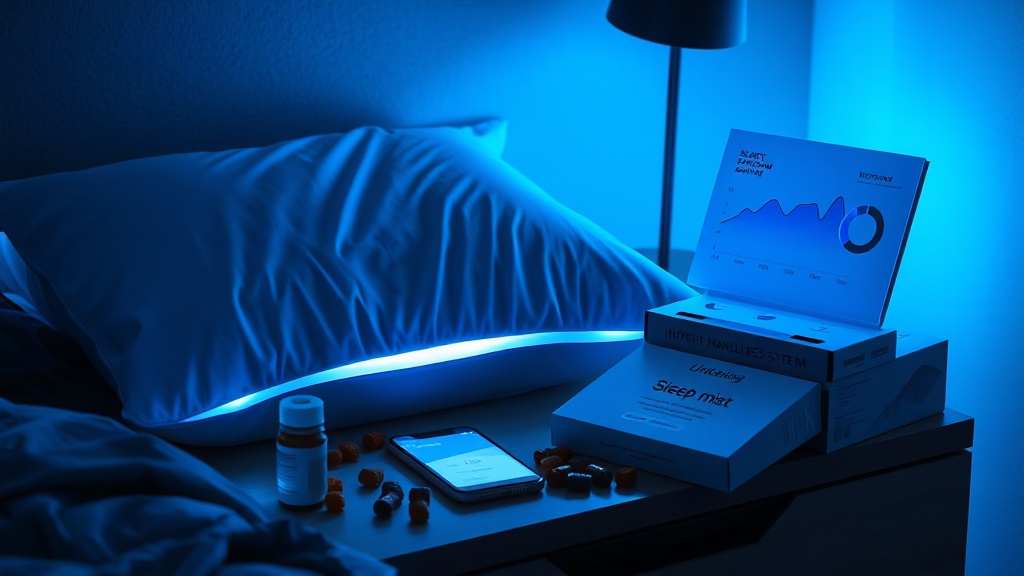
The current category leader in sleep panic marketing is the "smart pillow" — a cooling gel foam insert with embedded sensors that syncs to an app, tracks your sleep stages, and costs somewhere between $150 and $250.
What the marketing says: AI-powered sleep optimization for the most restorative rest of your life.
What the research says: Your sleep quality is primarily determined by room temperature (ideally 65-68°F) and pillow firmness (medium-firm supports spinal alignment, full stop). A 2023 review in Sleep Medicine Reviews found that cooling interventions modestly improved sleep onset — by about 8-12 minutes — but that passive cooling (a lower thermostat, a fan) performed comparably to active cooling products.
The "sleep tracking" feature is the real kicker. I tested three free apps — Sleep Cycle, Pillow, and Google's built-in sleep tracking in Fit — against each other for two weeks. Their sleep stage readouts disagreed with each other by 30-40 minutes on a given night. None of them were calibrated against a clinical polysomnography. They are all, in the most charitable framing, plausible estimates. The paid hardware sensors in the $189 pillow are doing the same thing with better marketing.
A $25-40 medium-firm pillow from Amazon's no-name tier — search for "cooling gel memory foam pillow" and sort by rating — is functionally close to the branded version for most sleepers. Lower your thermostat two degrees. Same core benefit. Total cost: your heating bill minus $2.
Weighted Blankets: The Science Is Real. The Price Is Made Up.
I want to be fair here because the weighted blanket category is not purely fraudulent. There is legitimate clinical evidence — including studies published in the Journal of Sleep Research — showing that deep pressure stimulation reduces anxiety and physiological arousal, and is associated with improved sleep onset in adults with anxiety. Deep pressure is real. It works for a lot of people. This is not a placebo.
The scam is the pricing, not the product.
Here is what determines a weighted blanket's effectiveness:
- Weight — should be approximately 10% of your body weight (so 15 lbs for a 150-lb person)
- Even weight distribution — glass beads sewn in pockets, not clumped
- Breathable fabric — cotton or bamboo outer shell, not polyester
That's it. That is the entire product specification. The construction is simple enough that no single brand can lock down the category — and they know it, which is why they spend so heavily on lifestyle photography and influencer partnerships instead.
Etsy sellers with good reviews are shipping 15-lb weighted blankets in cotton for $45-65. I've looked at five. The construction — bead fill, pocket stitching, fabric weight — is consistent with blankets I've seen selling for $200-250 at Gravity and Bearaby. The difference is not the blanket. It's the influencer fees built into the MSRP.
When you're shopping: look for sellers with 4.8+ stars and at least 200 reviews. Ask about bead type (glass, not plastic pellets — plastic shifts and clumps). Request a fabric sample if they offer it. Budget: $50-65 for 15-20 lbs.
The Melatonin Bundle Trap
This one makes me genuinely angry, which I know sounds like a strong reaction to supplement pricing, but stay with me.
Melatonin works for circadian phase shifting. The NIH evidence base on low-dose use is reasonably solid — 0.5mg to 3mg taken 30 minutes before your target bedtime can help advance your circadian phase. For DST specifically, taking a low dose (0.5-1mg) 30 minutes earlier than usual for a few nights is a legitimate strategy to ease the transition. Dosing questions and long-term use are still debated in the literature, but for short-term circadian adjustment, it's a reasonable tool.
The trap is the format and the bundling.
Melatonin gummies from branded sleep companies cost approximately $0.04-0.06 per milligram. Melatonin powder (from Bulk Supplements, which is third-party tested and available on Amazon) costs approximately $0.002 per milligram. That's a 20-30x markup for gummy candy—the same supplement markup pattern that makes vitamins so expensive.
The FDA does not distinguish between brand-name and generic melatonin. The molecule is the molecule. Costco's Kirkland melatonin — 5mg tablets, 300 count — works out to roughly a nickel a tablet. At the low doses most people actually need for circadian adjustment (0.5-1mg), you'd cut each tablet into quarters and spend a fraction of a cent per dose. Even at full 5mg, you're looking at about $15 for nearly a year of nightly use.
The brands bundle melatonin gummies with their blankets and pillows at "30% off bundle pricing" that still prices the melatonin at 15x the cost of a generic tablet. You're paying for the experience of unboxing a "sleep system."
Get the Kirkland. Start low (0.5-1mg for DST adjustment). Take it 30 minutes before your new target bedtime. Put the $40 you saved toward literally anything else.
What Actually Fixes the DST Shift (All Free or Nearly Free)
The circadian rhythm responds primarily to light. Not blankets. Not pillows. Not melatonin stacks delivered in linen-colored boxes.
The actual protocol:
Start Saturday night. Go to bed 15-20 minutes earlier than usual. Set your alarm 15-20 minutes earlier Sunday. You're pre-loading the shift instead of recovering from it.
Get outside at sunrise Sunday. Twenty minutes of outdoor light exposure in the morning advances your circadian clock more effectively than any supplement. This is free. It's called sunlight.
Keep your bedroom dark. Blackout curtains are the one product in the sleep category I will die on a hill for — not because they're fancy, but because they're effective and the markup is offensive. The $200 "sleep-optimized" blackout curtains sold by wellness brands are identical in function to the $19.99 ones on Amazon (search: "blackout curtains grommet top, set of 2"). The specification that matters is fabric density, not brand. Get the cheap ones. This markup strategy repeats across wellness—fear-based marketing to justify 10x premiums on functionally equivalent products.
Skip the screens. I know. I know. But the blue light and stimulation suppression thing is real — 60-90 minutes before target bedtime, or use Night Shift/Night Mode aggressively. This is free.
Don't nap Sunday. Power through the afternoon drowsiness. You will sleep better at your new target time.
That's the AASM-aligned protocol for DST adjustment. None of it costs $189.
Where to Actually Spend Money If You Have a Real Sleep Problem
If you have chronic insomnia that predates any time change — and chronic insomnia affects roughly 10% of adults — the gold standard treatment is CBT-I (Cognitive Behavioral Therapy for Insomnia). It has a higher long-term success rate than medication. The Sleep Foundation has a provider finder. Your insurance may cover it.
If you're not at the CBT-I stage and just want some tools:
- Weighted blanket: Etsy, $45-65, cotton, glass beads, 4.8+ stars
- Melatonin: Costco Kirkland 5mg, about $0.01/mg, start low for DST adjustment
- Blackout curtains: Amazon no-name, $19-25 per set, grommet top
- White noise: Your phone's free clock app (iOS and Android both have it) or a $15 basic machine. Not the $89 "sleep sound ecosystem."
- Sleep tracking: Sleep Cycle (free tier) or just the app your phone already has
Total spend to actually upgrade your sleep environment, not your marketing exposure: under $100. Probably under $80.
The emails are coming. "DST is 3 days away. Your sleep is at risk." Your inbox will be purple by Friday. The brands are counting on you being tired and suggestible.
You now know what they're selling and what it actually costs to make. Buy the blanket from an Etsy seller in Michigan. Get the Kirkland. Go outside Sunday morning.
Losing an hour is annoying. It does not require a $189 solution.
— Sloane
P.S. If you buy the $189 pillow anyway, I need you to know I will not judge you. I have a box full of evidence that I also got got. We just don't have to do it this time.